Séquence Didactique #4
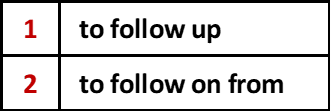
(faire un suivi, donner suite, faire le point) / (pour faire suite à)

=====================================
Rule of Thumb
“Follow up” et “follow on from” sont très utilisés dans la communication d’entreprise. Dans cet article nous donnerons donc 49 exemples contextualisés.
Par ailleurs, il faut savoir que les verbes à particule (phrasal verbs) sont très courants en Anglais (up, down, through, along, off, over etc…) alors que si peu familiers pour un francophone car nous n’en utilisons pas. Autre particularité, en anglais, énormément de verbes ont leur équivalent en phrasal verbs. Par exemple : to put off = to postpone / to show up = to arrive / to make up = to constitute, to form / to cut off = to separate from others, to isolate etc…ils sont partout !! L’avantage, c’est qu’on peut utiliser indifféremment l’une ou l’autre forme sans règle particulière, c’est selon ses habitudes…
La particule “up” est particulièrement utilisée et apporte deux sens majeurs (mais pas uniquement…) :
1) transforme le sens d’un verbe en sa version « figurée ». Exemple : open = ouvrir (une porte, un livre, etc…) deviendra to open up = ouvrir son esprit, une piste de réflexion, etc…). To give (donner) deviendra to give up (abandonner : to abandon what one is doing or planning to do)
2) renforce ou pousse l’action à son extrême. Ainsi, open up dans sa forme impérative « open up ! » signifiera « ouvre cette porte immédiatement ! ». De même, to eat deviendra to eat up pour signifier “finir de manger : Eat up your lunch !. Finis ton déjeuner ! To pay deviendra to pay up pour signifier « régler tout ce qu’on doit (particulièrement quand on ne le souhaiterait pas…» : Eventually they paid up, but only after receiving several reminders…
Les autres particules contribuent de la même façon à donner un sens spécifique à une verbe « généraliste » : off (éloignement par rapport à un point de départ), through (accomplissement, traversée d’un bout à l’autre, réussite), down (diminue ou rabaisse), over (déplacement d’un point à un autre) etc…
Un francophone aura malheureusement tendance à ne jamais utiliser ces prasal verbs alors qu’ils apportent incontestablement une British Touch à votre communication. Par exemple les expressions: « Let’s pick up where we left off : reprenons là où on s’était arrêté » ou “Pick yourself up, dust yourself off and start all over again ” (pick yourself up: relève toi) (dust yourself off: se reprendre, se ressaisir) (start all over again: et recommence tout à zéro) sont faciles à mémoriser; vous devriez donc vous les approprier!
=======================================
Teaching / Grooming
Voici une liste contextualisée de follow up (ainsi que le nom correspodant follow-up) et de follow on from (pour faire suite à) :
- In relation to point #xx below, we have a board meeting during the first week of May and will discuss with the family. I will follow up after the meeting.
- (…) and will follow up tomorrow morning if I haven’t heard back.
- I will be doing another on location follow up next Thursday afternoon.
- They have an excellent reputation for service and follow up.
- We don’t do a good job of follow up (on n’est pas très bon en suivi = on pourrait (on devrait) s’améliorer).
- Per our discussion, please follow up accordingly (“per our discussion” = comme discuté).
- Since I didn’t hear back from you, I wanted to follow up with our item on backorder (= reliquat de commande non livrée). Appreciate any follow-up.
- Please see the lead (= piste prospect), below from ITEMUX and follow up accordingly with this customer.
- Thank you for the follow-up note (= note de synthèse) from the HQ meeting.
- Hey Eric, hope all is well…Do you want me to follow up with your customer directly?
- I will follow up with the team tomorrow to see when the second payment of $510k will be wired (= virer; faire un virement bancaire).
- Following up on Flor’s note below (je fais suite au message de Flor).
- so you could follow up with the request or pass it along to one of your distributors in that region (notez: pass along to = transmit information / SYN: communicate, pass on).
- I shot you an email but thought I’d follow up with a text (notez: on peut parfaitement “shoot” un email mais aussi “drop” an email, a note etc…/ “I thought I’d (= I would)” est trés utilisé dans le sens “je préférais + verbe / text = SMS, texto).
- They would like to know what the timeline is (timeline: a plan for when things will happen or how long you think something will take – used especially in business English = calendrier, délai.), and would like to come in for a follow up as soon as it is ready.
- Follow up meeting in person on 15 Nov with M. and our team.
- The follow ups from our call today are noted below.
- Following on from our conversation we have asked them to build another 30 machines which will take our total stock holding to 81 (va porter notre stock à 81 pièces).
- Just as a follow up from our meeting on Friday
- Following on from our earlier telephone conversation I thought you may find the attached article from a specialist legal magazine of interest
- I have had a few follow up calls today and given your contact details out (voir la section Peks en bas de page).
- I am just following up regarding the contact you made with us.
- Following on from your email
- A quick follow up message to let you know that the below offer is due to expire tomorrow.
- This is a courtesy follow up to the email I sent over to you last week (notez: send over to).
- Also following on from Bob’s questions do you have any update on the expected date of the new software?
- Following on from the previous sales meeting where we spoke about getting more customer face time.
- Hi Chris, following on from our conversation I have prepared a (…)
- Hi Bob, just a follow up to my mail below last week.
- Yes, absolutely crucial that we follow up.
- and we have a date set for next Wednesday to follow up on the progress.
- Just to keep you informed, the follow up meeting due to happen this afternoon has been moved to Friday morning, (notez: move a meeting)
- so I will email you with an update / progress following the meeting.
- Hi Hervé, following on from your email below, I have attached a proposed agenda to send to Bob.
- I am just following up on the payment agreement we had in place (…). Please can you confirm the payment status?
- and this will be followed up internally and processed on JDE as normal (comme d’habitude)
- Hi Folks, attached is the summary of last week’s e-shot (l’e-shot es ten envoi d’emails en masse très utilisé en Marketing) for following up and tidying up the customer base (tidy up: nettoyer, purger).
- I just wanted to follow up on my email below as I had a conversation with another customer
- Hi folks, attached is the summary of last week’s e-shot for info and follow up.
- Thanks for following up on this.(merci d’avoir fait suite = de t’en être occupé. La forme progessive “ing” s’utilise pour marquer le fait que l’action a bien eu lieu).
- Following on from my post yesterday about the challenges around recycling coffee cups,
- Following on from the email below are you able to offer any support?
- Party’s over (la fête est finie)…now the real work of following up on leads begins.
- Please ensure that you fill these in with details of the discussion and what follow up actions are required and when.
- Hi – as a follow up to the email below,
- Following on from the installation of the replacement Firewall the other week, we will …
- I hadn’t heard anything further so thought that it was sorted (j’ai pensé que c’était réglé) but will follow up with them now.
- if you could please review the contacts in these lists to ensure that they are followed up with quickly
- Which we will be following up with phone calls.
========================================
Perks (tips)
Contact details
Quand on veut donner ses coordonnées (nom, email, tel, adresse) ou les demander à son interlocuteur on utilise « contact details » qui peut aussi se réduire à « details »
- We have agreed the way forward is for me to provide her contact details directly to Mr. G. so that he (…)
- Our primary contact will be Dale Binner. If you require contact details from Dale, please do email TTX and we will pass on details.
- I have asked for contact details for placing orders and will share with you once I have it.
- My contact details below.
- It was great to meet you again at the exhibition in Cardiff, as you requested please find my contact details below.
- I have had a few follow up calls today and given your contact details out (prasal verb: give out = ici, distribuer, remettre).
- Full contact details are below and I have attached a members list for your convenience.
- I will send you over my customers contact details (phrasal verb: send over = faire parvenir)
- For your information, here are the contact details of the lady I’ve been put in touch with regarding designing the reception area.
- You have been given all the contact details on several occasions.
- Also could you please confirm your Skype contact details..?
- Thanks Bob, remind me of the contact details for the UK? I can’t find them.
- He says it will become compulsory for venues to take customer contact details for track and trace.
- Thanks, I’ll pass on your contact details and let him know that tomorrow would be convenient.
- New legal requirement to record the contact details of customers, visitors and staff on their premises.
- Most venues required customers to provide contact details to support contact tracing,
- Your details have been passed over to me by our UK branch as their main Distributor for London (phrasal verb: pass over to = transmettre, communiquer)
- Hi Mike, I hope you are well. Your details have been passed over to me by Bob (voir point 17 ci-dessus).
- I have been passed your details from Caroline relating to some work that you had done on (…)
- “If a pub or restaurant doesn’t ask for your details … move on, go elsewhere, because that premises is not keeping you safe.”
- I have sent your details across to Dale.
- please call me on 07781 xxxxx and if unanswered please leave a voicemail with your details.
- I can pass his details onto you or ask him for a CV.
- I have copied him into this email so you have his details.
- Thanks Nigel. Do you have his details at all ? (at all (= in any way, to any extent) pourrait ici se traduire par « quelquepart » « par hasard » et s’ajoute souvent en fin de question pour souligner le point, (différent donc de la forme négative que nous connaissons tous : not at all). Par exemple : “Hi – Hope you are well? I was wondering if you were free for a chat at all?” ou “Here’s the draft of tomorrow’s e-shot – please let me know if you think we need to adjust it at all“ou “Did you sit down at all?” est-ce que tu t’es assis quelquepart ? (dans la pièce) ou “Are you at all interested? No, not the least bit” ou encore “She works full time and if she has children at all it will be as late as possible
That’s all from me for now, as soon as I have development to share I will be in touch. 😉👌
(*) to cause an activity or process to continue = tenir le rythme, veiller à ce que tout marche bien: “(…) so we will be able to outline our next steps and put a plan in place so as to keep the ball rolling”
=== oooooooooooooooooo ===
SOMMAIRE – Accès direct aux Séquences Didactiques https://soundssooenglish.uk/table-des-matieres/
========= ooOoo =========
 Sounds soho British!