

Séquence Didactique # 10
Dans cette séquence nous allons peaufiner vos connaissances en matière d’agenda, c’est-à-dire essentiellement négocier vos créneaux horaires, comment les valider, comment finaliser une date etc… Il y a quelques petites formules toute simples (voir ci-dessous mes 66 tournures idiomatiques), ne nécessitant aucune connaissance particulière de la langue de Shakespeare, mais n’oublions que ce blog est surtout destiné à redorer votre «British Touch» ⭐️⭐️⭐️

En bonus, dans la section Fun Facts nous parlerons des «unsociable hours»… cela potentiellement nous concerne tous au travail un jour ou l’autre. Et nous pousserons le bouchon jusqu’au concept du «quiet quitting» (mais qu’est-ce donc cela ?…) qui a décolé depuis que “the American TikTokker @zaidlepplin posted a video on it that went viral, saying “work is not your life“…
oooooooooooooooooooooooooooooooooooooooooooo
What do you need to know? 🌍
Diary
Ce petit mot rappellera certainement aux “Boomers” (tongue in cheek!)(*)… Bridget Jones’s Diary et pourtant, il très utilisé dans les échanges commerciaux ! So What about YOUR Diary ?

- Thanks for mail and explanations. Can you come to our offices on Tues 3rd July at 11.00 am?- No problem at all. In the diary.
- when you have available time in the diary.
- If this is possible do you have any time in your diary over the next week or two to accommodate our visit? (= pour nous permettre de venir, pour nous recevoir).
- Unfortunately we now have limited availability due to Michael’s diary and travel plans. Slots (voir paragraphe suivant) we have available are: Mon 23 @ 2:30pm / Tue 24 @ 2:30pm
- Just checking that this is in your diary.
- Sky Garden Night: Friday 25th January, 2019: Mark the date in your diary
- I’d love to arrange something around your diary (= en fonction de votre agenda).
- Just checking, I have note in my diary to meet up (= se voir) tomorrow, but I’m not sure we confirmed details.
- Can the delivery/collection dates fit in with (= cadrer, coller) our current transport diary, and we slot them in (voir paragraphe suivant) when we are in the area?
- Let me know when would be a good time to talk, either in person over a coffee or on the phone. Looking at my diary I’m free early next week?
- Fabulous. I have sent a diary request (= une invitation électronique) ) to yourself.
- Mitch – It would be good to get a date on the diary. Maybe week commencing 11th?
- Please could you let me know which suits best according to your diaries, or if you are flexible and we can decide..? – I’m flexible and can work with any of the dates/times below.
- Due to Mark’s diary being moved around late on Friday (= en raison d’un changement dans l’agenda de…) he is now available for a call at 1:30pm UK time on Tuesday.
- I look forward to hearing back from you so that we can get a date in the diary
- I am just trying to align a couple of my teams diaries as I would also like them involved in the call.
- I’ve shared a diary invite for next Monday. Do let me know if any of these don’t work with diaries and we will try to move these to accommodate (= voir point 3).
- I’ll send calendar invites out (= invitation à une confcall) (notez: to send out an invite) to reserve the slots (voir paragraphe suivant) in people’s diaries.
- I don’t have any plans but if I don’t book them in my diary time will run away with me! (= perdre le contrôle, échapper à qqn)
- The smartest clients I’ve had (…) they make space in a packed diary to make that relationship work.
- Can we diarize a weekly conference call? (= to write down your future arrangements, meetings, etc. in a diary)
- Building a sales pipeline, diarising (voir point 21. Notez en American English on utilise un “z” alors qu’en British English, c’est un “s”… il en va de même de la plupart des verbes se terminant par cette sonorité) quality sales appointments for your sellers.
- We have time available on Tuesday 8th March if that suits your diaries?
- I’ve managed to catch up with the team this afternoon, and we can move the meeting to 09:30 (virtually) to suit diaries – I’ll do this now.
- Does Wednesday 04th May at 10am work for you and your diaries.
- Reserving slots (voir paragraphe suivant) in your diaries for now. Full attendance list TBC (= To Be Confirmed) nearer the time
- Put September 14th in your diary as the Exhibition in London is less than 2 months away!
- Tomorrow would be ideal, do you have a preference of time, and we can arrange our diaries to suit?
To slot in / a (time) slot = programmer, caser, glisser dans son agenda / un créneau horaire
- I am pleased to offer you a 30- minute slot at the next meeting.
- Keeping the same format as last year, each slot is 8 minutes, including changeover time (ici = temps de transition entre deux RV successifs).
- at the moment I am not in a position to offer you a slot, as the meetings are heavily oversubscribed (= surchargé, rempli).
- Can the delivery/collection dates/times fit in with our current transport diary, and we slot them in when we are in the area, as we currently do ?
- How can I assist? Have you got a slot to schedule a call or a meeting to understand your requirements in more detail?
- I wonder if it might be a good idea to look at a speaking slot (= envisager un temps de parole) at next year’s expo.
- We’re looking to complete the Manager’s appraisals next week and would like to firm up time slots (voir paragraphe suivant) to do this. Available slots would be Tue 25 Feb 10-12 and Tue 25 Feb 2-4
- In the meantime I will ask Michael to keep this timeslot free.
- Please ask Mike to reserve this timeslot pending confirmation (pending sth: en attendant, dans l’attente de) from HQ.
- Morning everyone. Sorry to be a bother (= Désolé de vous déranger), but I can t find a delivery slot for any of the supermarkets, so if anyone is going shopping today, could you please get us a litre of full milk,
- If WX20 is going to stay in the underground car park in it’s current slot (ici = emplacement de parking) could the owner please park it further in, as it makes getting my car in and out very difficult. Thanks in advance, Andy (109).
- Either for me / Either is fine for me. / Either slot would be fine for me (= les 2 crénaux me conviennent)
- The Expo Hub has been quiet to be honest ….my slot was 10 – 1 and I did not get anyone reach out for a chat (= prendre contact pour discuter)
- so as not to lose the slot completely and just string them out (= faire traîner, faire patienter. Notez: string along = «mener en bateau» il y a un côté «arnaque» à la différence de string out) a bit longer.
- the perfect time to plan a trip to the show, and maybe slot in a bit of sightseeing too! (= faire/caser un peu de tourisme)
- Reserving slots in your diaries for now. Full attendance list TBC nearer the time (= à l’approche de la date; on pourrait aussi utiliser l’expression « nearer the date »).
To firm up (arrange firmly = “firm up one’s plans”) = régler les derniers détails de [qch], finaliser.
- Please let me know your thoughts so we can firm up a date and make our travel arrangements.
- Can we firm up numbers of attendees in the next few days please so that we can make the necessary meal and accommodation reservations?
- We also need to firm up the colour for the background.
- We’re looking to complete the Manager’s appraisals next week and would like to firm up time slots to do this. Available slots would be Tue 25 Feb 10-12 and Tue 25 Feb 2-4
Fine / OK with me (or by me) = used to indicate complete agreement: That works for me!
- Good with me. Thanks.
- Ok with me
- All (term of address to start an email), Any date ok with me.
- All well with me, how are you settling in with the UK automotive industry? (settle in = to become or help to become adapted to and at ease in a new home, environment, etc)
- Thanks for your email, 18 December is good with me
- 2pm is good with me, I shall see you Tuesday.
- Yes Tuesday afternoon is good with me.
- Either part A or C is fine with me, whichever is more sturdy (= solide).
- 9.30 works with me, shall I call you or did you want to call me?
- Hi John, that is fine with me, thank you for letting me know.
- …if that’s ok? – Hi, good with me
- All good with me thank you, hope you are too ?? (= tout va bien pour moi, j’espère que pour toi aussi)
- It wasn’t really resonating with me (= ça ne me parlait pas vraiment)
- Hi Bob, yes all ok with me thanks. How’s things with you?
- That’s fine by me, just wanted to see what other people’s views were on this (= ce que les autres en pensaient).
- I’ll wait to hear if we need an in depth asbestos survey (= recherche de la présence d’amiante), but in the meantime fine by me.
- OK ? – Yup fine by me
- Nothing that can’t be sorted out, thankfully (= rien qui ne puisse être réglé). The 28th is fine by me. Will 10.00 be ok, please?

oooooooooooooooooooooooooooooooooooooooooooo
“Fun Facts” 😱
Unsocial / unsociable hours (British) = incompatible with social life: horaires contraignants, horaires décalés.
If someone works unsocial hours (also unsociable hours), they work late at night, early in the morning, at weekends, or on public holidays = happening during the days of the week or hours of the day when most people do not have to work. Unsocial working hours (also known as anti-social hours) are common among shift workers. It’s work that takes place outside of the traditional (9am to 5pm) schedule.
- a job with unsocial hours
- I don’t want to work unsocial hours.
- (…) to support staff with high quality hot meals when they are working unsociable hours, such as night shifts, bank holidays or weekends.
Staggered Shifts = Horaires décalés (staggered: en quinconce)
Très fréquemment utilisées pendant le COVID les Staggered Shifts permettent de réduire très fortement les risques de surfréquentation des lieux de travail au moment des arrivées et des départs des équipes, en décalant (par exemple d’1 heure) ces plages horaires par groupe de salariés. Ainsi, au lieu de voir tout le monde arriver en même temps à 8:30 le matin et repartir à 17:00, on regroupe les personnel en 2 ou 3 groupes auxquels on assigne des heures d’arrivée et de départ bien spécifiques.
Employees arrive and depart work at different times in shifts. Shifts may be staggered anywhere from 15 minutes to two hours. This means that shifts are staggered to reduce the number of employees arriving and leaving a worksite at one time. For example, some shifts may be 8:00 to 4:30, others 8:30 to 5:00, and others 9:00 to 5:30.
- Your university may take steps to help with social distancing, such as staggered start and finish times for lectures (= conférences).
- “Because of the planned staggered return, we were told that teachers were preparing online, blended learning” (= mode mixte: a style of education in which students learn via electronic and online media as well as traditional face-to-face teaching. Also known as hybrid learning).
- They are going from being safe inside venues with staggered closing times to unsafe on overcrowded streets and overloaded public transport
To work odd hours = travailler en horaires décalés
By definition, occupations with odd hours are those that take place on evenings or weekends, during times like the middle of the night or even across seven days a week. While working odd hours can be unpredictable and stressful, it can also suit those who are easily bored and like to be challenged. The phrase refers therefore to unusual hours, irregular hours. It is mostly used in a sinister context…Note: In this occurrence ”odd” means: unusual, occasional, random, periodical, fragmentary.
- Once you enter showbiz, you are supposed to work odd hours.
- “He works odd hours, starting at 10 pm and finishing at 3 pm”
- The odd hours may also mean “extra hours as and when needed”
- “He works the odd hour or two at the pub when they are busy”. +/- faire des extras
The odd occasion/day/moment/ drink etc… (especially British English) est utilisé pour parler d’une activité ou d’un moment particulier qui ne se produit que de façon épisodique, irrégulière, non programmée; on pourrait dire qui se produit “de ci, de là” = occasional
- Lack of sleep doesn’t matter on the odd occasion. Le manque de sommeil n’a pas d’importance à l’occasion.
- I take the odd day off work. Je prends un jour de congé de temps en temps.
- I like the odd glass of wine with my dinner. J’aime boire un verre de vin à l’occasion pour accompagner mon dîner.
- Jo smokes the odd cigarette. Jo fume une cigarette de ci, de là.
- This doesn’t matter on the odd occasion; it is only a problem if it occurs regularly. Cela n’a pas d’importance à l’occasion ; ce n’est un problème que si cela se produit régulièrement.
- The odd jobs. des petits boulots (qu’on fait de ci, de là)
- We had the odd sunny day Nous avons eu quelques journées ensoleillées.
- He likes the odd drink Il aime bien boire un verre à l’occasion
- Is anyone having the odd glass of wine? quelqu’un voudrait un petit verre de vin ?
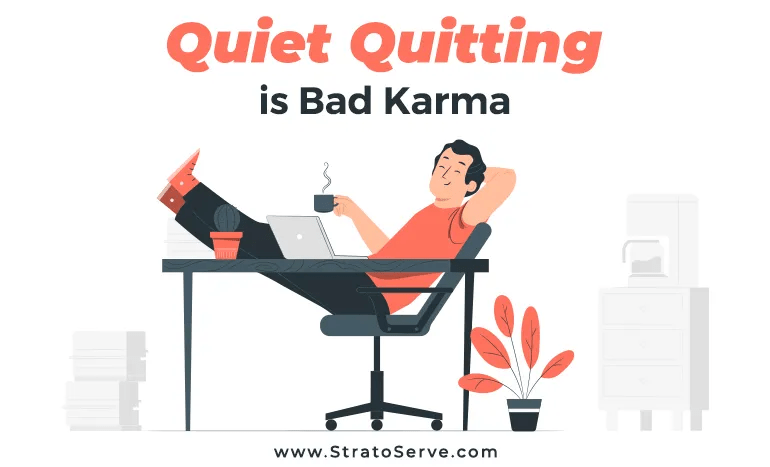
What is quiet quitting?
Despite the name, it actually has nothing to do with quitting your job 🛑⚠️
Le « quiet quitting » signifie « démission silencieuse ».

Ce concept s’applique à un employé qui se désengage de son travail mais ne le quitte pas concrètement, se contentant d’effectuer le strict minimum de sorte qu’on ne peut plus attendre de lui qu’il se surpasse. Cela se manifeste par un comportement minimaliste, fini le « above and beyond » (= in excess of the expectations or demands. Far beyond what is required) ou le « going the extra mile » (= make a special effort -more effort than is expected of you- to achieve something). Ce serait plutôt: respect des horaires à la minute près, ne pas répondre aux sollicitations en dehors de sa « job description », ne pas se donner la peine d’aider une collègue etc…
Certains employés disent donc “Stop!” 🛑au travers de la «quiet quitting» attitude, qui peut se voir soit comme une réponse à la surcharge de travail et au fait que l’équilibre entre vie professionnelle et vie privée n’est pas respecté par des managers très envahissants (…), soit comme une forme d’appel à l’aide, le besoin d’un soutien plus important pour se réengager dans l’entreprise, se motiver, voire tout simplement, trouver un travail plus « fun »…
It means doing only what your job demands and nothing more. Quitting doing anything extra. You still show up for work, but stay strictly within the boundaries of your job requirements. So no more helping out with additional tasks or checking emails outside work hours.
As the recent trend in “quiet quitting” has revealed, many people are losing passion for careers they once loved. You may have done everything within your power to attain the perfect job, and yet the daily grind sometimes saps you of your enthusiasm. Voir lien BBC ci-dessous.
https://www.bbc.co.uk/news/business-62638908

That’s all from me, thanks for following along. This blog will continue next week.
Love 🥰
(*) avec ironie, ironiquement
—
=== oooooooooooooooooo ===
SOMMAIRE – Accès direct aux Séquences Didactiques https://soundssooenglish.uk/table-des-matieres/
========= ooOoo =========
 Sounds soho British!